
Why Passive Income From Stocks Still Beats Every Alternative
If you're chasing passive income from stocks, you're competing against savings accounts paying 4%, bonds yielding similar amounts, and real estate that demands your time and capital upfront. Dividend-paying stocks solve a problem those alternatives can't: they let your income grow automatically, year after year, without you lifting a finger. The S&P 500's average dividend yield sits near 1.3% today, but that headline number hides the real opportunity — companies compounding their payouts at 8%, 10%, even 15% annually.
That's the distinction most investors miss. A 2% yield growing 12% a year will out-earn a static 5% yield within a decade. This article breaks down three dividend growers with the balance sheets, market position, and cash flow discipline to keep raising checks to shareholders regardless of what the Fed does next.
The Psychology Behind Dividend Investing Right Now
Investors are nervous. The market's flirted with all-time highs while whispers of a slowdown persist, and the 10-year Treasury yield has bounced between 4% and 4.5% for months. That uncertainty is exactly why dividend growth stocks are trending — they offer a bond-like income stream with equity-like upside, and a paper trail of resilience through past recessions.
"The best dividend stocks aren't the ones with the highest yield today — they're the ones that will still be paying, and raising, that dividend in 2035."
That's the mental model professional income investors use, and it's the lens for every pick below.

stock ticker board with dividend arrows.
Pick #1: A Dividend King With Four Decades of Raises
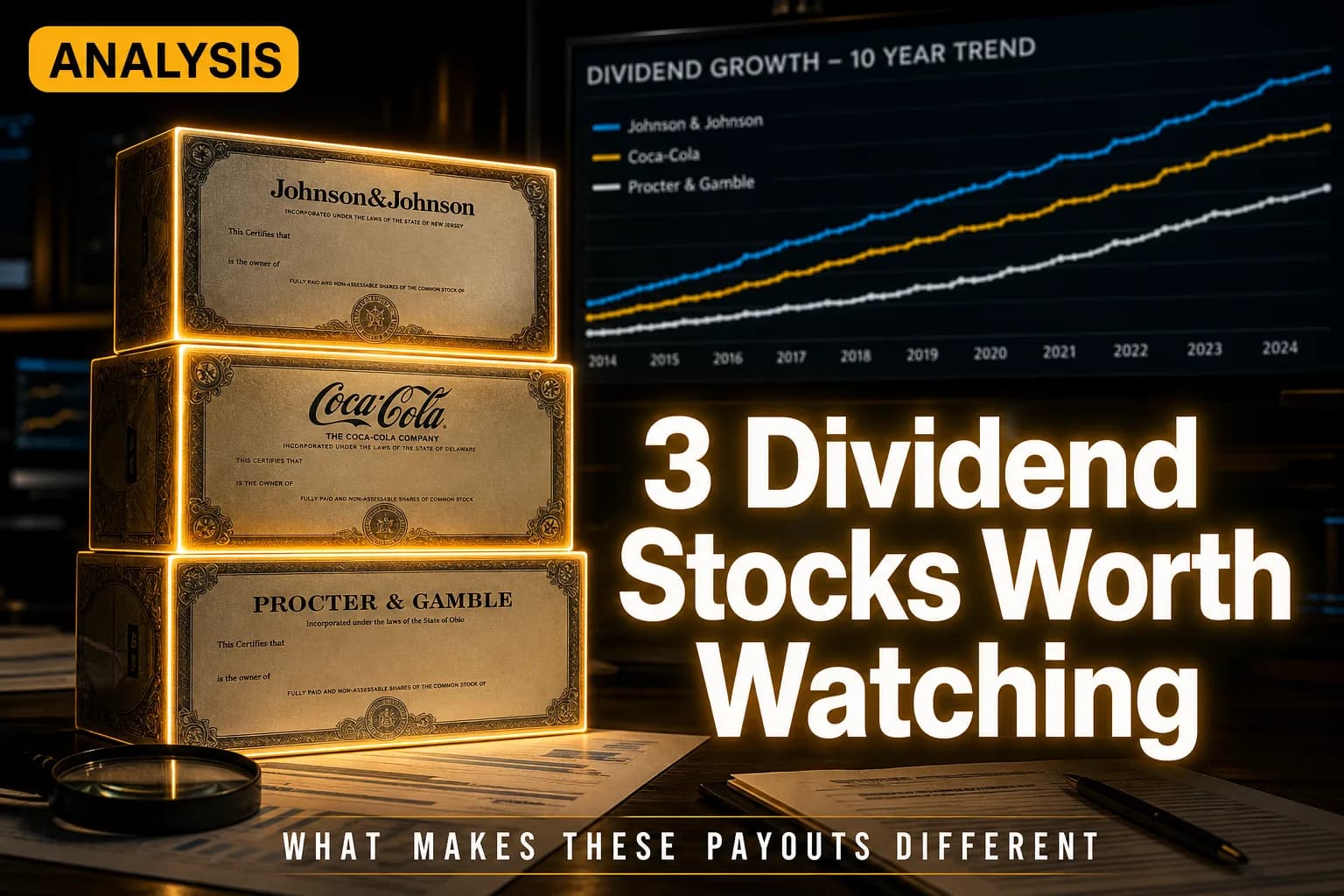
Johnson & Johnson (NYSE: JNJ) has raised its dividend for 62 consecutive years, surviving the dot-com crash, the 2008 financial crisis, and a global pandemic without missing a beat. The current yield sits around 3.2%, backed by a payout ratio near 45% — meaning less than half of earnings go toward the dividend, leaving massive room for reinvestment and future raises.
Revenue diversification is the real story here. J&J's MedTech and pharmaceutical segments generated over $88 billion combined in trailing revenue, insulating the company from any single product's patent cliff. For anyone building passive income from stocks for the long haul, a Dividend King with this kind of earnings cushion is about as close to "unstoppable" as public markets get.
Pick #2: The Toll Booth Business Model
Realty Income (NYSE: O) — nicknamed "The Monthly Dividend Company" — pays shareholders every single month instead of quarterly, and has increased that payment 129 times since its 1994 NYSE listing. The current yield hovers around 5.6%, and the REIT owns more than 15,000 properties leased to tenants like Walgreens, 7-Eleven, and Dollar General under long-term net-lease agreements.
Net leases push property taxes, insurance, and maintenance onto tenants, which protects Realty Income's margins even during inflationary spikes. Occupancy has stayed above 96% for over two decades, a streak that survived the 2020 pandemic shutdown. For income investors who want cash flow that arrives monthly rather than quarterly, this is one of the few dividend growth stocks structured specifically around that convenience.

monthly calendar with cash deposits.
Pick #3: The Toll Road of Digital Infrastructure
Broadcom (NASDAQ: AVGO) doesn't scream "dividend stock" the way J&J or Realty Income do, but its transformation into an AI-and-networking infrastructure giant has fueled a payout that's grown from $0.66 per share quarterly in 2016 to well over $5.50 today. The current yield sits closer to 1.2%, low compared to the others, but the dividend growth rate — often exceeding 10% annually — is the real draw.