A 28-year-old spending $48,000 a year doesn't need $48,000 in annual dividends to retire — she needs roughly $1.2 million invested, which is a completely different number than most Gen Z retirement content will tell you.
That gap between "income I need" and "money I need to generate it" is where almost every passive income retirement plan falls apart. Search "how much passive income to retire" and you'll find vague encouragement about dividend stocks and rental properties, but almost nothing that shows the actual arithmetic. Money.com's recent coverage of Gen Z's retirement anxiety captured the sentiment correctly — a 2024 Natixis survey found Gen Z believes they'll need $1.63 million to retire comfortably — but sentiment isn't a plan. This article is the plan.
How Much Passive Income to Retire, in One Formula
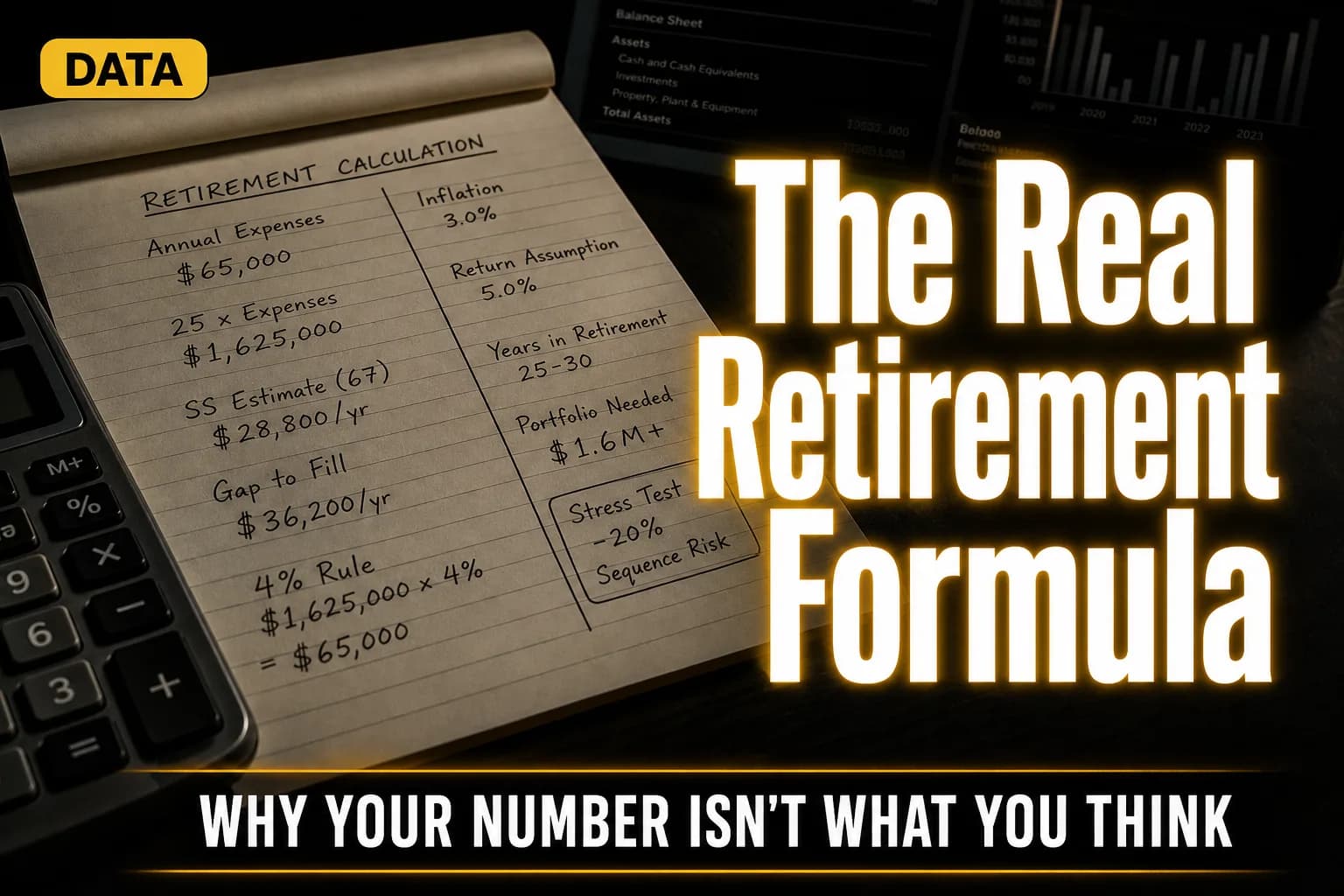
The starting point is your annual spending, not your income, not your salary, not some round number you saw on TikTok. Take your realistic annual expenses in retirement — housing, food, insurance, travel, the works — and multiply by 25. That's the "25x rule," derived from the 4% withdrawal rate popularized by the 1998 Trinity Study out of Trinity University, which tested how long a portfolio survives at various withdrawal rates across rolling historical periods.
If you spend $60,000 a year, you need $1.5 million invested. Spend $40,000, and it drops to $1 million. Spend $100,000, and you're targeting $2.5 million. The math is the same whether that $1.5 million sits in index funds, dividend stocks, rental equity, or a mix — the multiple doesn't care about the source, only the total.
Here's the part most guides skip: the 4% rule assumes a 30-year retirement horizon and a portfolio of roughly 50-75% stocks. Retire at 35 instead of 65, and you're now planning for a 50-60 year runway, which pushes safer withdrawal rates down toward 3% to 3.25% according to updated research from Wade Pfau at The American College of Financial Services. At 3.25%, that same $60,000 lifestyle requires closer to $1.85 million.
Why Dividend Yield Math Changes the Number Completely
Withdrawal-rate retirement (the 25x rule) assumes you're selling shares over time. Pure passive-income retirement — living only off dividends, interest, or rental cash flow without touching principal — is a different game with different math, and it usually demands more capital, not less.
Say you want $60,000 a year entirely from dividends, and you're holding a portfolio yielding 3.5%, which is roughly where a diversified dividend-focused ETF like Schwab's SCHD sits as of 2024. Divide $60,000 by 0.035 and you need $1.71 million — more than the withdrawal-rate approach because you're never dipping into the principal that's also generating growth.
Push for a higher yield to shrink that number and you introduce new risk. A portfolio yielding 7-8% (think certain REITs, BDCs, or covered-call funds) would only require $750,000 to $860,000 to hit $60,000 annually. But high-yield vehicles frequently carry higher volatility and dividend-cut risk — Medical Properties Trust cut its dividend by 50% in 2023, and AGNC Investment has cut its payout multiple times since 2014. Chasing yield to lower your "number" can quietly raise your actual risk.

calculator with dividend yield chart.
What Actually Changes Your Retirement Number
Three variables move this calculation more than anything else, and none of them are "which stock should I buy."
Your withdrawal rate assumption. Dropping from 4% to 3% doesn't sound dramatic, but it increases your required nest egg by 33%. A $1.5 million target becomes $2 million overnight, purely from a more conservative assumption about how long your money needs to last.
Your retirement age. Someone retiring at 65 can lean on a 4-4.5% withdrawal rate with reasonable safety, per Morningstar's 2023 retirement income research. Someone retiring at 40 needs closer to 3-3.25%, because the portfolio has to survive twice as long, through more recessions, more inflation cycles, and more sequence-of-returns risk — the danger of a market crash hitting right as you start withdrawing.
Inflation, quietly, every year. $60,000 today doesn't buy $60,000 of goods in 20 years. At 3% average inflation, you'd need about $108,000 annually in year 20 to maintain the same lifestyle, which means your "number" isn't static — it's a moving target that most retirement calculators understate.
Is Passive Income From Real Estate a Faster Path?
Rental property gets pitched constantly in passive income retirement circles, and the appeal is real: rents tend to rise with inflation, offering a natural hedge that fixed-income assets lack. But "passive" is doing a lot of work in that sentence.