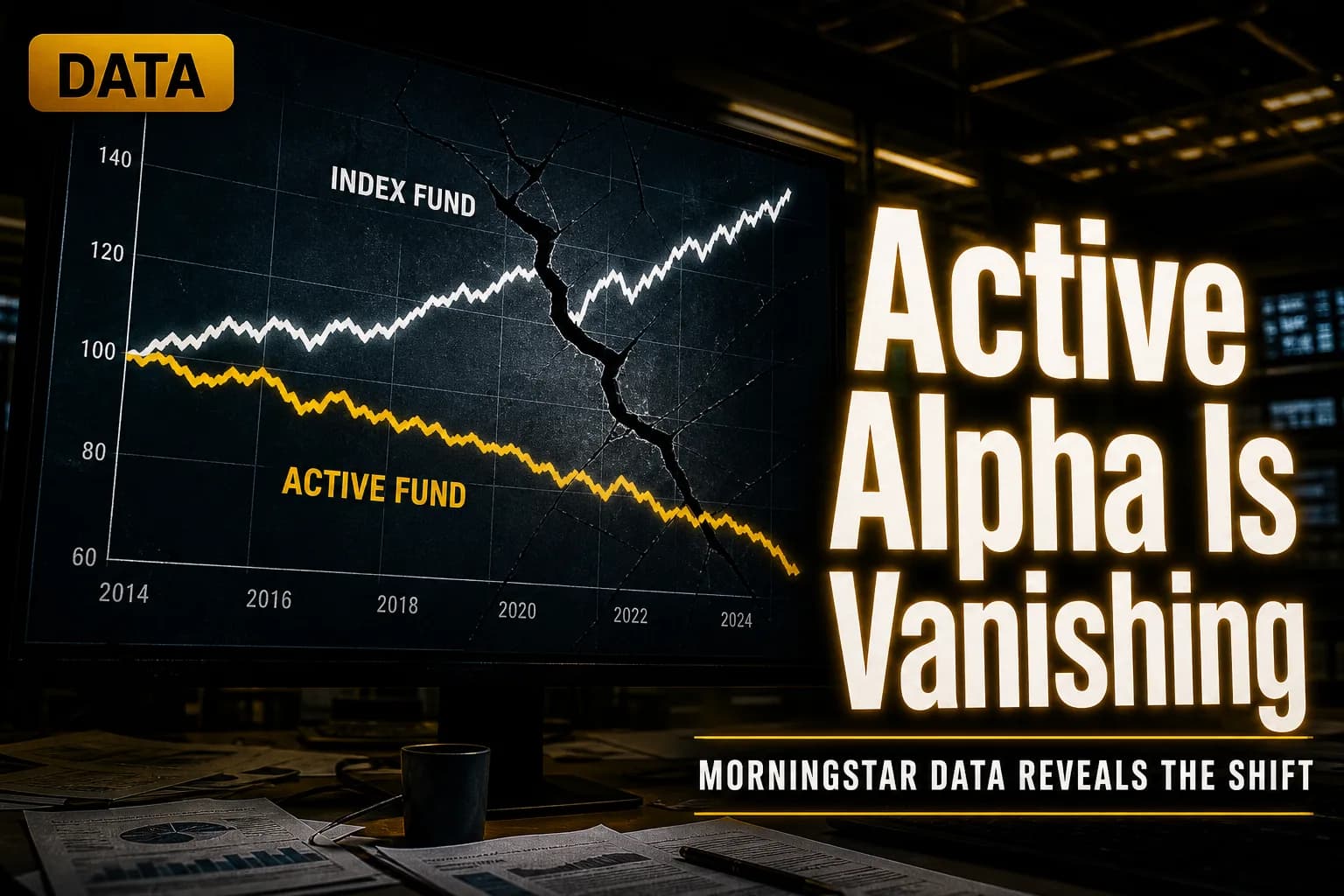
Active fund managers who once relied on mispriced stocks to beat the market are running out of mistakes to find. That's the uncomfortable data point buried in new Morningstar research: as passive investing has swallowed a larger share of the market, the gap between winning and losing active funds has narrowed, and the average active manager's edge — their "alpha" — has shrunk with it. The passive investing vs active investing debate usually gets framed as a fee argument. Morningstar's numbers suggest something structurally bigger is happening underneath.
Here's the mechanism. Active managers generate returns above the market by exploiting pricing errors — a stock trading below its real value, a sector the market has misjudged. Passive funds don't hunt for those errors; they buy everything in an index, in proportion, regardless of price. Morningstar's analysis found that as passive ownership of U.S. equities has climbed toward roughly half the market, the dispersion of returns among active managers has compressed, meaning fewer errors are left for stock-pickers to find and profit from.
What Morningstar Actually Found
Morningstar's research team tracked the relationship between passive fund flows and the success rate of active managers across multiple market segments over more than a decade. The core finding: as an asset class or sector sees a larger share of assets held by index funds, the active managers competing in that same space see their odds of beating the benchmark decline further. This isn't a one-year blip tied to a hot market cycle — Morningstar's own semiannual "Active/Passive Barometer" has shown for years that fewer than half of active funds survive and beat their passive benchmark over a 10-year period, and the newer research points to passive scale itself as a contributing cause, not just a coincidence.
The logic compounds. When index funds dominate a category, the stocks left mispriced enough to be worth trading shrink in number and in size. Active managers then compete against each other for a smaller pool of exploitable opportunities, which pushes down the average alpha available to all of them, even the skilled ones. Morningstar frames this as a structural headwind distinct from the usual complaints about high fees or manager skill.

index fund chart declining alpha.
Who Gains When Active Alpha Shrinks
Everyday index fund investors are the clearest winners here, at least in one sense. If active managers collectively have less alpha to capture, the argument for paying 0.60% to 1% in expense ratios for active management gets weaker every year, reinforcing the already-strong case for low-cost index funds charging 0.03% to 0.10%. Vanguard, which pioneered low-cost indexing, and BlackRock's iShares unit, the two largest managers of passive assets in the U.S., both benefit directly from any data point that makes the passive case look stronger — more assets flowing into their funds means more fee revenue even at razor-thin margins, because the volume is enormous.
Large institutional active managers with genuine, repeatable skill also gain relatively, even if their absolute alpha shrinks. A smaller pool of active competitors chasing a smaller pool of mispricing means the managers who do have real skill face less crowding from mediocre competitors — some of whom get squeezed out entirely as their after-fee returns fail to justify their cost.
Who Loses in This Shift
Mid-tier active fund managers lose the most. These are funds without a distinctive strategy or standout historical track record, charging active-level fees while producing returns that increasingly resemble an index fund's, minus the expense ratio. Morningstar's long-running barometer data already shows the majority of active funds in most categories fail to beat their benchmark over 10 years; a further erosion of available alpha makes that survival math worse, not better.
Financial advisors who built client relationships around active fund selection face a harder sell too. If the data shows shrinking alpha is a market-wide structural trend rather than a temporary dip, the pitch that "our fund's stock-picking will beat the index" gets tougher to defend, particularly to clients who read the same Morningstar coverage.
There's a less obvious loser: long-term market efficiency itself, according to some of the researchers and strategists Morningstar cites. If passive investing keeps growing as a share of total market ownership, fewer participants are actively analyzing individual company fundamentals and setting prices through that analysis. Prices could become less reflective of true company value over time, even though no single passive investor is trying to cause that outcome.
The Strongest Case Against This Framing
The most serious counterargument: even if aggregate active alpha is shrinking, that doesn't mean the passive-vs-active math has meaningfully changed for the typical investor, because most active funds were already losing to the index before this trend accelerated. Morningstar's own barometer has shown that in a typical 10-year period, the average active U.S. equity fund underperforms its passive counterpart after fees regardless of alpha compression. Critics of the "shrinking alpha" framing argue Morningstar is documenting a trend that reinforces a conclusion investors already reached a decade ago, rather than revealing something new that should change behavior.